
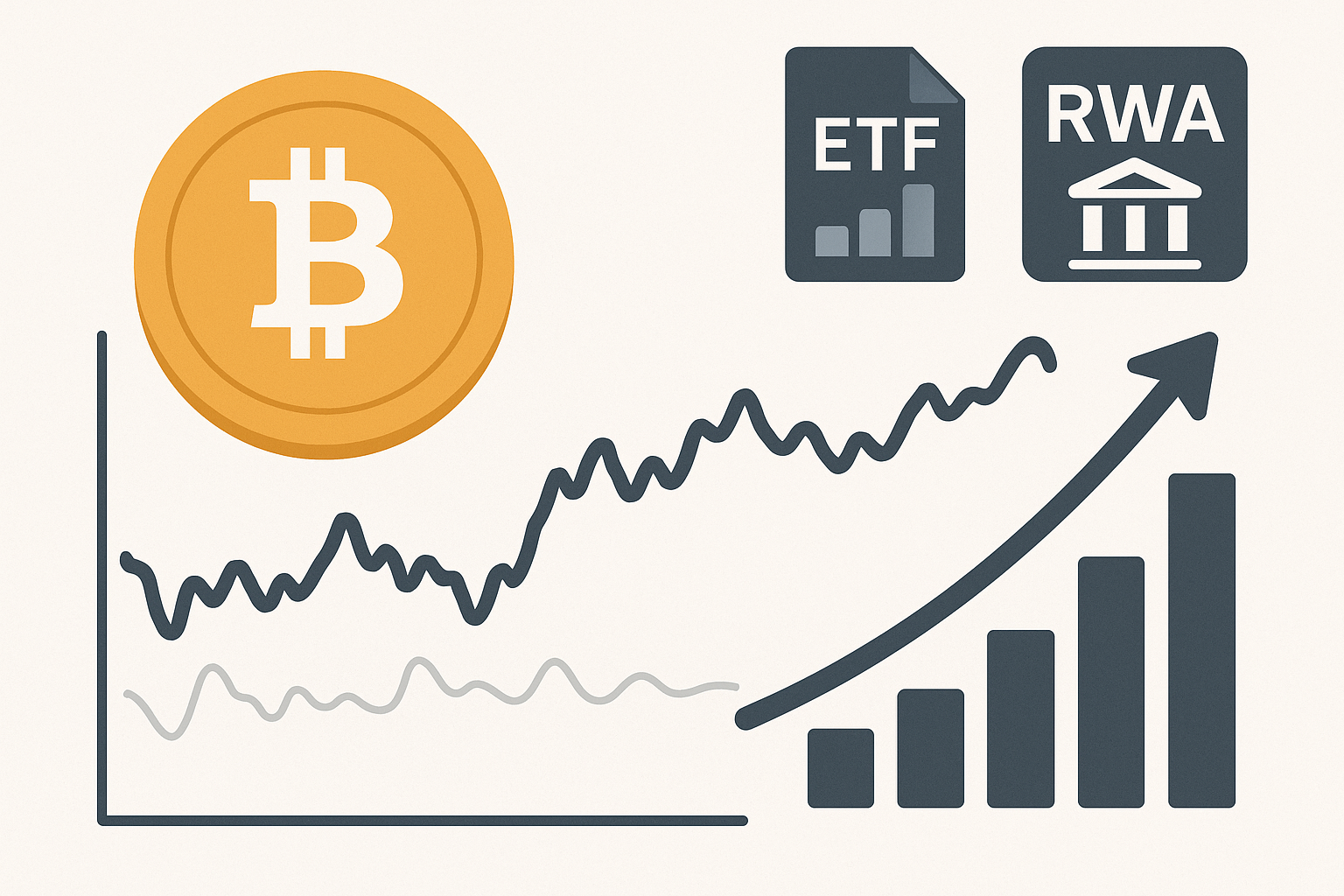
Bitcoin’s 2025 cycle shows rising institutional flows, lower volatility, and deeper liquidity.
Tokenized real-world assets surge to $24 billion, boosting institutional adoption and on-chain activity.
ETFs reshape Bitcoin liquidity as stablecoins remain key rails in a more mature digital asset market.
Bitcoin’s latest cycle is developing under a very different market structure, with data from Glassnode and Fasanara Capital pointing to deeper institutional participation, rapid growth in tokenized real-world assets, and a notable drop in volatility.
Their
Q4 Digital Assets Report
highlights how Bitcoin’s behaviour has shifted as regulated investment channels expand, and liquidity becomes more stable across spot, derivatives, and on-chain markets.
The findings show how ETF flows, settlement activity, and broader adoption of tokenised instruments are shaping a more mature phase in the digital asset ecosystem.
These structural changes are defining how capital moves through Bitcoin in 2025.
Institutional flows reshape the cycle
The report estimated that Bitcoin has absorbed around $732 billion in new capital during this cycle.
This has occurred alongside a clear decline in one-year realised volatility, which has fallen by nearly half.
Glassnode linked this trend to increased depth across major markets and a larger share of trading driven by institutional strategies.
Glassnode also reported that Bitcoin settled approximately $6.9 trillion over the past 90 days.
This puts Bitcoin in a range comparable to payment networks such as Visa and Mastercard.
Even with more trading moving into ETF and brokerage channels, the report found that Bitcoin and stablecoins still dominate value transfer on public blockchains.
ETF channels deepen liquidity
ETF-linked demand has reshaped how investment enters and exits Bitcoin.
Instead of relying mainly on on-chain movement or exchange activity, a greater share of flows now passes through regulated investment vehicles.
According to the report, this shift has encouraged smoother liquidity conditions and fewer sharp price changes in spot markets.
Traditional market makers and arbitrage firms have increased their presence due to ETF participation.
Their involvement has tightened spreads and reduced disruption during periods of heightened selling pressure.
This development reflects a broader alignment between digital asset markets and established financial infrastructure.
Tokenized RWAs accelerate
Tokenized real-world assets have expanded from $7 billion to $24 billion within one year.
Glassnode stated that this rise reflects stronger institutional demand, including interest from pension funds, hedge funds, and corporations that want on-chain exposure to familiar financial instruments.
Tokenized funds have gained momentum as asset managers test new distribution models and investors seek simplified access to traditional assets.
Platforms involved in tokenised RWAs haveУсилены системы хранения, расчетов и соответствия требованиям.
Эта основа способствовала стабильным притокам на протяжении всего 2025 года, поддерживая растущий сегмент рынка, который связывает традиционные активы с Блокчейн-инфраструктурой для расчетов.
Роль стейблкоинов укрепляется
Glassnode охарактеризовал рыночную структуру как более крупную и стабильную по сравнению с предыдущими циклами.
Данные указали на более глубокую ликвидность на спотовых, деривативных и ончейн-каналах, что способствовало более сбалансированной торговой среде.
Сниженная волатильность стала определяющей чертой цикла, сформированной институциональными торговыми стратегиями, которые склонны использовать устойчивые модели распределения.
Стейблкоины продолжают служить ключевыми связующими звеньями между традиционными и цифровыми финансовыми системами.
В отчете указано, что спрос на расчеты в стейблкоинах остается значительным как на централизованных, так и на децентрализованных платформах.
Glassnode охарактеризовал созданную стейблкоинами и традиционной инфраструктурой двухуровневую систему как постоянную часть экосистемы, поддерживающую как институциональные потоки, так и розничную торговую активность.
Аналитики, упомянутые в отчете, ожидают расширения институционального участия по мере роста принятия токенизированных фондов.
Glassnode представил эту фазу как переломный момент, отмеченный усилением институциональных потоков, ростом токенизации и снижением волатильности.
Эти факторы свидетельствуют о том, что Bitcoin и более широкий сектор цифровых активов переходят в более структурно зрелую среду в 2025 году.
Запись
Отчет Glassnode раскрывает растущую стабильность Bitcoin на фоне активности ETF и расширения RWA
впервые появилась на
CoinJournal
.
Источник: ссылка